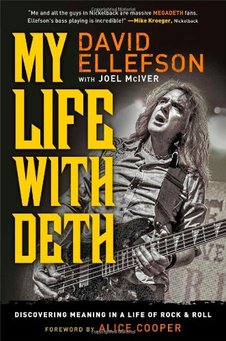
.Join me from 5-7pm Eastern (23:00-1:00 CET) at 91.1 WRUW Cleveland ( wruw.org). Big show for you today featuring interviews with MEGADETH and TOURNIQUET! First we'll have David Ellefson, who will be talking about the Megadeth's new album, Super Collider. Putting it nicely, the single has been met with mixed reviews, and that was the first question I asked. After that, we'll hear from Ted Kirkpatrick, drummer and creative force behind Tourniquet. They returned in a big way last year with Antiseptic Bloodbath, and Ted tells us about the album, the new 'voiceless' version, and his ongoing involvement in animal welfare.
Two interviews and lots of new music coming your way on today's Metal Meltdown with Dr. Metal. The first is with Jon Schaffer of Iced Earth, which comes just as their 2-disc live album, Live in Ancient Kourion, hits the streets. Jon had a lot of interesting stories to share about the live recording. We'll also have an interview with Fabio Calluori of the Italian power metal band Heimdall. It's been a long time since we've heard from them, but they returned to the scene in a big way this spring with the release of Aeneid, a concept album based on Vergil's epic poem from the 1st century BCE. Join me from 5-7pm Eastern (23:00-01:00 CET) at WRUW-FM 91.1 Cleveland and wruw.org on the web.
In the second half of my extensive interview with André Matos , we cover some very interesting ground. André describes in detail what it was like to record Angels Cry almost 20 years ago. From recording in a WWII-era bunker to being forced by Charlie Bauerfeind to fire their original drummer, there is some great stuff here about what I consider one of the most important power metal albums of all time. From there, we move on to discuss the recording of André's third and latest solo album, The Turn of the Lights. Finally, he describes in detail what happened with the short-lived Symfonia, his involvement with Avantasia, and the current state of his relationship with Angra. I've included highlights below, but I would encourage you to listen to the full audio, as there is a lot there. Thanks again to André for doing this interview, which I feel provided great insight into his life and career.
This is the first half of my extensive interview with Andre Matos, who has recently released his third solo album, The Turn of the Lights. He earned his place in the pantheon of metal singers long ago, recording his first album with Viper at the age of 15 before going on to found the legendary band Angra a few years later. In 16 years of doing my radio show, I have been fortunate to conduct many interviews with many musicians, but this is one that immediately stands out in my mind. Clocking in at over two hours, Andre gives us an in-depth look at much of his career, especially the early years. Enjoy the full audio and text highlights from the first half of our conversation below, and then come back on Friday for the second half in which Andre tells us all about the recording of Angels Cry before moving on to his more recent experiences in Symphonia and as a solo artist.
Back home from touring the States with Uli Jon Roth, I caught up with Henning Basse for an in-depth discussion about his experiences on the road and his musical career as a whole. With Metalium defunct, he is keeping himself quite busy singing with Uli, Sons of Seasons, and MaYaN. Among many interesting stories in this chat, you'll hear about him filling in for Kai Hansen at a moment's notice years ago in the middle of a tour. I also had no idea that Henning had auditioned for both Gamma Ray and Savatage years ago, and he describes those experiences in great detail for us. To top it all off, he also reveals some news about Bruce Dickinson's future solo plans. It's always a pleasure to talk to someone with an extensive background who is willing to share both his successes and disappointments, and this is exactly what you'll hear in this interview. Thanks so much to Henning for his time and for giving us such good insight into his work. Below you will find the full audio and contents. I've typed several highlights as well.
Bringer of Light got my attention at the very first listen, going on to rank 7th in my 2012 Albums list. Add the vocals of PelleK to catchy songs and a big production, and you have one hell of a power metal album. After being released in Japan last year, the album is finally out elsewhere via Massacre Records. I caught up with both PelleK and Will Graney via Skype for an extensive conversation about Bringer of Light and their backgrounds in the music business. You can really tell these guys are excited about Damnation Angels by the enthusiasm in their voices, and I suspect that this is just the start of something big. I encourage you to listen to the complete interview, but those in a hurry will find a few highlights here. HighlightsThe current state of the music business and its impact on Bringer of Light: I honestly don't believe that your money comes truly from your record sales. nowadays a lot of big bands make their money on tour with merchandise. I think that's how it works nowadays. The internet has completely changed it. In some ways, it's good. A lot more people can hear your music. It's easier to access it. At the same time, in that year gap between releasing it in Japan and worldwide, our album was illegally downloaded so many times, and I think that really maybe hurt the release as well a bit. [Will] I don't feel like people buy music to hear the music anymore because it's always accessible on the internet. I feel like people buy the music to just show the support. So I think it's a lot on us to reach out to the fans and make people want to buy it to support us and to hear more music. No matter how small or big a release, you can always get the music on websites and on YouTube. [PelleK] PelleK on his YouTube covers: It's a nice hobby. So whenever I don't have any work to do or any big recordings or touring, I just like to communicate with people that way, and I think maybe even that helps sales in the long run. And also, I think it's important to not just focus on selling but actually just being a person like everyone else. We're just people, aren't we?The way I always work with that is I record bass and drums myself, and keyboards. I play easy bass line, so it's not so hard. I get someone to do the guitars. Someone else records guitars, and then I have the backing track for it. Then I practice a little bit, and then I turn on the camera and film it. That's pretty much it. The big sound behind Bringer of Light: I think that's a big thing that makes us really unique is Will's ability to orchestrate the way he does. It's really man vs. equipment then. Listen to how other people can make orchestrating sound compared to Will. It's just insane, to be honest, how he makes the strings, for instance, sound. It's awesome. That's how Pride sounds so huge at times. It's a massive orchestra with so many instruments completing each other. [PelleK] When we write songs, there's nothing in there for the sake of it. We don't force anything, we don't put orchestra in for the sake of it. There's no ego...We put everything in, we put as much work on each instrument. We concentrate just as much on the riffing as we do on the orchestra. Most power metal bands, I don't know what their influences are. For this album, we were trying to master it to Dark Horse by Nickelback. I mean, that might sound like a shock, but we were working on the sound of the drums and the guitars to Metallica and Nickelback. You listen to a lot of symphonic metal bands, and it often does sound thin. The production's thin. We wanted a big, live sound, a big drum kit. You could tell the drum was hitting it hard. You know, the riffs are big. We wanted nothing to be small. We didn't want the orchestra to power through and the guitars to be quiet. We wanted everything to be powerful and stand out at certain points. [Will] If we could use a full orchestra, then we'd use an orchestra. We're trying to seem like we're using a full orchestra. It is tricky. A lot of the instruments on the album are done on the computer, some of them are live. But if we could have a real orchestra, that'd be amazing, but we're trying to compete with that. So we're basically trying to do the best job we can with technology. [Will]
Fresh off the release of Sacrifice, I had a chance to catch up with Biff last week to talk about the album and what the band is doing these days. It's impressive to see him and the band still going strong after all these years. With Avantasia's 'The Mystery of Time' coming soon, I was eager to get the details on the songs Biff did, and he describes what that was like. Transcribing significant portions of this interview proved challenging due to audio and accent, and so you'll find what I could manage below. Personally, I would suggest simply listening to the audio. HighlightsSacrifice: Well, I wanted it to be a pounding album, sort of an assault on your senses, really. Got not balance on this album, just full-on from the word 'go'. I just wanted the guys to play Gibsons and Marshalls and just give it their best shot, really, and go back and try and figure out what we had then that we could bring to the party again now. On a couple of songs, we did that, really.On regrets: I think you can always look back, can't you? You can always look back and say, 'I wish I hadn't married her', either. There are a few things you can go back and look at. There were a few albums that were a bit, as we say in England, dodgy, but they always had a couple of great songs on them. So I suppose we kept in there because we always had some great songs.Producing and mixing Sacrifice: I think because we're a well-known band worldwide, we can get really great people to work with us, so I think that helps. You know, Andy Sneap mixed the album. He's quite current and has done a lot of big albums for people. I suppose that gives us a modern edge. I think when you've been together so long, people want to work with you, which is always great. I wanted to produce it myself this time and bring a bit of a flavor of that to the album. I've known Andy for some time, and we wanted to do some work together. So he got some spare time, really. So he wanted to work with us, and he loves our music anyway. He's not just doing hardcore bands. It did work out perfectly.
We went for a more powerful sound just by recording things very well and playing things really loud, which is what we're good at. His input into the album is making it sound great.Recording technologies: We've always been making albums, so we've sort of adapted ourselves through the digital revolution. And we're able to swing backwards and forwards from analog to digital and into any sort of technology. Some things are better the old way. Some things are better the new way.Balancing old and new sounds: It's quite hard to mix the retro with the modern, that's quite a hard trick that we do. We obviously have Paul Quinn, who's been in the band forever. And we have Douglas, who has been in the band since 1995, so I suppose Doug brings a different style of guitar playing to the band. So it's great, really. It's worked out really well, the chemistry. Working with Tobias Sammet on Avantasia's The Mystery of Time: He did ask me on the first one, but I couldn't do it, but I think Alice Cooper did my bits on that one. Or I didn't do the bits, and he did them. They weren't particularly my bits. This one, he asked me, and I was available. So he came to England, and we did them in the studio there. We're mates, anyway, he sang a couple times on stage with us. We're quite good friends. He's obviously a huge Saxon fan. I was singing about a black orchid, I think. I think that was the point. It's a rock opera, so it's very difficult, unless you sit down and hear it all, it's very difficult to get an angle on it, if you know what I mean. So I was just singing lines, really, that he wanted me to sing. It sounded great, though. We were there for a day, but I think we drank wine for most of the day, and then I sang for maybe three or four hours. Future Saxon releases: I could see us doing a concept album. I don't think it could be an opera about one particular thing or person. Solo album? I'm thinking about it. I might do something after this year when we finish touring. We'll see how it goes. Playing with Metallica back in 2011: It's good, it's really good. We're big mates, so it's nice to go and sing with your friends. I sang in Paris with them, in France, and then obviously I flew over for their 30th anniversary. So it's nice, it's really nice of them to come out and say we influenced them. That's great, and they're a great band as well.Metallica in the 90s: All bands that have had huge albums at some point in their career, the ones after that can always be a bit overcriticized. You had The Black Album, which was massive, and then to come up with something as good as that is nearly impossible. We had the same trouble in the 80s, to come up with something better than Denim and Leather or Power & The Glory. It's very hard. They're so big, those songs.
 Dr. Metal with Pär and Joakim in Cleveland (Apr. 2012) When it came to choosing the 2012 Album of the Year, Carolus Rex stood out far and above the pack. It was therefore a real privilege to talk to Pär recently and revisit the album, its success, and the tours which have followed. He was clearly battling a cold at the time of the interview, and I really appreciate him powering through and bringing us up to speed on what's happening in the band. Of particular note in this interview: information about the upcoming DVD release, plans for the next studio album, what it's like to self-manage the band, and the current lineup of the band with Snowy Snaw filling in for Robben on drums. Below you will find highlights, but I encourage you to listen to the full audio above. On the forthcoming DVD/CD: In Sweden, we play only Swedish songs. That's what people want. So definitely, the setlist looks different in Sweden. In late this year, we will release a live DVD of Sabaton, where there will be an edition where you can see shows from several places. And then you will be able to see the difference how a show in Sweden looks like versus a show in, for example, London, or Oberhausen, Germany, or Poland...We have not decided if there's going to be a CD to it, but likely, yes.The lost music videos for Carolus Rex: Right after the last US tour, we went to record two music videos. Unfortunately, we don't know what happened to the guy who edited them, or filmed them, so at the moment, we are not sure what's going to happen. It feels very, very annoying, and very weird, because we normally have pretty good control over what we are doing. But this time, we have lost the control, which feels bad. We're going to go there, we filmed it in Poland, and we're going to try to find out what happened.No keyboardist yet: This thing, that we didn't have the time to find a keyboard player during that time, we decided to put the keyboards on prerecorded. Then we didn't know how it was going to work out. Now we know that it worked out really, really fine. So we are not really at the moment looking for a keyboard player. It's definitely not going to happen during the touring period of the album. Maybe when we write another album, maybe we find out, 'Maybe we should take in a keyboard player and try.' But before that, we're not going to care for that. We like it the way it is.On managing the band: Well, it is a lot of work, of course. It means that every day there is several hours that needs to be done by emailing and on the phone to do the business part. But, what else to do? Drink and **** ? That's the only thing I can think of, and without that, it would drive you mad if I didn't have a lot of things to do and just sit down and do nothing. So I'm that kind of guy. I like to have a lot of things to do, and I like to be involved, I like to plan some routings and business things. So I don't mind that at all. It is a lot of work, though, but I like it.
There is also the aspect about money. There is not as much money in the business as there used to be, so there is not as much money in the music business at all. People don't sell millions of albums anymore, and touring becomes more and more complicated because more and more bands increase ticket price, and the competition is higher for the crowds. The whole situation has become that there is less money for the bands. It's as simple as that. That means also that you cannot hire people to do anything. You just have to learn to do as much as possible for yourself in order to survive on the small amount of money that there is left for the artists.
There is a lot of people who have over the years tried to become the management of Sabaton. We know when we are ready, and we know what we are looking for in a management. And we're not just looking for somebody who thinks like the ordinary metal manager. We need to think outside of the box a lot. When we find the right persons or the right company, then we'll have a manager. Before that, it's our wish, and it's our rules, and we're doing well. I'm sure there is somebody who can do it better, but until we can find him and everything feels right, we're going to do it ourselves.Robben's hiatus: He was very quick in announcing, when he found out that 'Okay, I'm going to have a baby, guys. How are we going to do this?' We were like, 'Okay, thanks for the heads up so far in advance.' So then we had time to locate another drummer. And he was always like, 'I'm not going to let you down, guys, so if you don't find another drummer, I'll play, but I would be happy if you guys find another one to fill in for me.'Snowy Shaw on drums: We're not sure exactly how long Snowy's going to be with us, because he has plans of his own. He's got his own band, he's planning to make an album for himself, a solo album. There's a lot of things he wants to do, so I don't think he's going to stay in Sabaton for too long, but he's welcome to stay while Robben is taking vacation. For the moment it works out fine, so we're just going on.Connecting to local audiences: We try as much as possible. I want to know as much as possible. When we come to a city or a new country, I like to know a little bit more about the city and what to expect. When I look at the maps, I try to plan and route things, and see what it is going on. There is a lot of thought behind this. We also interact a lot with the fans to know what they think, and what they want, and what they like and don't like. Without interacting with the fans, we can never know what they want.Polish Woodstock in Summer 2012: The show went pretty well, to say. 600,000 people came, and it was a magic night. Because we were recording it, the feeling is never there, because you have to focus on how you play. So you can't really enjoy the atmosphere that much. We should have done that show without recording it - that would have been awesome, because then we could have relaxed more.
It's always an honor to talk to Kai Hansen, one of the founding fathers of German metal. I caught up with him just as he finished up the band's new EP, Master of Confusion, due out March 15th. It's been at least 10 years since I've interviewed Kai, and it was really great to talk to him again. He's always a great interview, as he tends to give thoughtful, detailed responses. I especially wanted to express my sincere appreciation for Skeletons & Majesties Live, which I consider one of the best live albums in recent memory. In playing and recording their lesser known songs live, as they did on Skeletons in the Closet, they do something that few bands to this date have dared to do. One can only hope that other classic bands will follow suit at some point. You'll hear about the EP, why they chose to cover Sweet, how they put together Skeletons, what it's like to record without Daniel Zimmermann on drums, and what's planned for Unisonic. You'll find several highlights below, but I would encourage you to listen to the audio, as he said a lot of interesting things during our conversation. HighlightsMaster of Confusion: We got two brand new songs that we actually wrote for the upcoming album, but since we saw that it would be kind of impossible to make it for a full length album towards the tour, we said 'Well, we don't want to go on tour naked. We want people to listen to some new stuff, at least something,' so we said, 'Let's take two songs which are in some way representative for the album and record them, and add up two cover versions plus some live stuff. Covering Sweet's 'Lost Angels': Definitely one of my absolute favorite songs from Sweet. I mean, there's many, but this is one of them, a song I really love from the point they put it out. It's called 'Lost Angels', and it's very nice. It was on the later albums, but it was a great song. Actually, this is the only song from the new recorded stuff that has been drummed by Daniel still, because we had already recorded the drums and bass for this song, and we never finished it. So we dug it out, and this time we made it. Actually, we could see while working on this song how much this band actually has done in terms of playing and being really good. All the choirs, and the guitar work is really brilliant, and it's not so easy to reproduce or pick up. But I think we did a real good job on it. And whenever I'm going to meet Andy, I'm going to play it for him and give him a copy and see what he thinks, but I think he's going to be alright with it. Daniel Zimmermann's departure: It was a hard time since he left. We had the feeling, and of course it came along with me playing in Unisonic and especially for Dirk and Henjo, this kind of feeling that the band starts to fall apart. And for me, it was like falling into a black hole. This lineup was stable, and we were happy, and it was great, and Daniel is somebody you cannot just replace. He was a very unique guy and unique drummer, and he was a real big part of Gamma Ray as well. So when he actually left, we were kind of hanging there and didn't really know, because nobody really wanted to go for this 'Oh, we're looking for a drummer, let's do auditions' shit. For a while we were hoping he might change his mind, and we kept things open. Skeletons & Majesties Live: Let's write down all the songs on a list that would be in the boat to be played and give that to our fan club people and let them make a choice. And it's a tough thing, because with our fans there's always some songs that are favored by everybody, but the rest is divided up so much that it was kind of a tough thing. We put our own opinion on top, and then finally we had a setlist that we were ready to rehearse, and made a few changes here and there. And then of course we included this acoustic part to make the whole thing kind of different and interesting. I think we're happy with the outcome now. Michael Kiske joining them on Skeletons: We said, 'Since we want to play something from the Helloween era, wouldn't it great if Michael, since he's now back to going on stages again and being out in the open, ask him if he wants to join in.' And of course, it wouldn't be enough if he just sings one song, so let's try to find something special. So I came up with the idea pretty late. I said, 'Listen, man, we have this kind of vocal/piano/ballad thing, and wouldn't it be great if we did that as a harmony thing?' And we actually didn't even have time to rehearse it here in the rehearsal room. So I think it was pretty spontaneous, and we both partly fucked up the lyrics, but I think it was very entertaining for us and the audience as well. It is definitely something special.Sharing the stage with Michael again: It is new and old at the same time. It seems very familiar in some way, and in the other way we're not the same persons anymore as we used to be. Only part of us is, but some other things have changed. So that's the point where you start to really find yourself and check out what the other is doing and how he's responding to things you do on stage and so on. But that was kind of easy play for us, and maybe that comes from our past.The future of Unisonic: We came up with this 'one year is a Gamma Ray year, one year is a Unisonic year' policy, and we'll try to keep that working. Of course, that doesn't mean that the other band is completely resting in the respective year, but priority is one band at a time for me. Otherwise I couldn't handle things. So now at the moment, I'm concentrating on Gamma Ray, and I don't think about Unisonic too much. And whenever I'm done with this here, and we've done our album and touring, it's time to get back to Unisonic and start songwriting. On getting older: I know that we're not a young band anymore, and of course we're at this point where you really put some concrete under what you have and make it really stable, or that you as well might lose it, and just wimp out and go down the drain, which definitely we're not planning to do. State of the metal scene: Metal is vital, man. Metal is like a fucking dragon with many heads, and each time a head is chopped off, a new one grows on the other side. So it's still there, it's alive, it's been mixing up with all kinds of music and influences and styles, from jazz to folk to whatever. Still the basics, and what it's all about, is that there's a certain need for rough sounds, for aggression, for power, and for this kind of feeling of kicking ass, and that's what unites us. Technology: What can you say? I just stand in awe and watch, and think 'Well…' You will not turn any wheel back. It's going to roll on, until we're complete techno zombies with individual iGlasses that keep us away from real life and just leave us in the digital world with movies and music and tits and asses, whatever. You know, that's the way it is, and I'd rather take my guitar and play.Digital downloads: It's more about what a band is creating in total, and that's not dependent on albums, even though albums are still in people's minds as the thing. And, of course, well that's with rock music. If it comes to radio pop, nobody gives a fuck about the album. It's just the song or the two songs, the hits. The rest, don't care. Even those people who buy the album still or download it, but normally it's more about the songs, and the songs that stick out. You know, it's fair, because no one is forced to buy an album and then maybe have like 3 or 4 songs that he actually likes, and the rest, he says, 'Well, average. Don't need. Still have to buy it.' On the other hand, the artists are full of shit because it's like they're doing a painting, and you don't sell the painting as a whole. People come up and say, 'Yeah, I'll only take this part of the painting, and the corner down on the left,' and you'll sign. It's kind of weird. The inspiration for Master of Confusion: The lyrics are about our own kind of confusion, because as musicians we are not office and businessmen that are always on time, that have a fixed plan about the schedule of the day, and all that stuff, and we like it that way. We are chaotic in some way. We can organize ourselves, but we don't run on a fixed schedule all the time. So that means that many times, and that of course includes our private life (girlfriends, and kids, and people surrounding us, friends), things get to be chaotic. So, somebody's waiting for you, you're not on time, you fuck a date up, whatever. Things like that happen. So that's the thing behind the 'Master of Confusion' stuff, even the record label. It's all in the lyrics.
|